
How does workers' comp work in New Jersey?
Business Owners can buy workers' comp coverage from over 400 private insurance companies licensed to sell workers' compensation insurance in New Jersey. Most NJ employers shop their coverage with insurance agents or brokers authorized to sell coverage in the state. A lot of agencies don't have many appointments with insurance companies because of premium production requirements. At Workers Compensation Shop.com, we're appointed with over 35 of the top New Jersey carriers.
Learn more about New Jersey workers compensation rules and regulations below. If you have any question about your policy, or coverage in general, give one of our Specialists a call so we can help find the right coverage for your business.
Workers' Comp Rules & Information for New Jersey
Workers Compensation Regulation in NJ
New Jersey Department of Insurance
20 West State Street
Trenton, NJ 08625
609-292-5360
New Jersey Division of Workers Compensation
PO Box 381
Trenton, NJ 08625-0381
609-984-2515
New Jersey Employee Definition
New Jersey laws for workers compensation utilize a very liberal definition for employees. The NJ court system uses two basic tests: 1) Control Test and 2) Relative Nature of Work Test. If the business retains the right to supervise and control how the work is done than an employment relationship is established under the Control Test. If an individual relies on the income from a business and the work performed is integral to the business, then an employment relationship exists under the Relative Nature of Work Test. Only one of these tests need to be met to establish an employer-employee relationship for workers compensation in New Jersey.
NJ Second Injury Fund
The Second Injury Fund (SIT) makes benefit payments to injured workers who become permanently disabled as a result of work-related accidents when and if the employee had a pre-existing disability. The program is administered by the Division of Workers Compensation and is designed to encourage employers to hire workers with prior disabilities. .
New Jersey Uninsured Employers Fund
An Uninsured Employers Fund was established in New Jersey to pay the medical expenses and temporary disability benefits to injured workers when an employer fails to provide the legally required coverage and refuses to pay benefit payments awarded by the courts. Liens against the employer are then made by the Superior Court for any amounts paid from the fund..
New Jersey Cross Match Program
The Office of Special Compensation Funds conducts regular database searches the Department of Banking and Insurance's Compensation Rating Bureau and NJCRIB to identify uninsured business owners who have employees. Employers who receive a letter and Cross Match Response Form must provide the information on the form as soon as possible to verify coverage. Penalties may still be assessed for any period of time a NJ employer was uninsured.
Office of Special Compensation Funds
Cross Match Program
PO Box 399
Trenton, NJ 08625-0399
Fax: 609-633-7783
NJ Eligibility for Workers' Comp Benefits
All medical expenses related to an injury should be paid by the insurance company. Temporary disability payments are not paid by the carrier unless the employee is unable to work for 7 days; however, benefits are retroactive to the first day of lost wages. In the event of a permanent disability, payments are due regardless of the number of lost work days.
NJ workers' comp laws prohibit business owners from firing or decimating against any employee because they file, or attempt to file, a workers compensation claim.
NJ Construction Classification Premium Adjustment Program
This program is applicable to business owners in the construction industry. The program offers a reduction in workers' comp premiums when the average wage levels exceed a predetermined threshold mandated by the state. Employers are generally notified of eligibility by the NJCRIB and must file for the credit each year.
New Jersey Premium Discounts
All policies developing a standard premium greater than $5,000 are eligible to receive automatic premium discounts. The discounts are given as a percentage of gross premium and are a function of overall cost of premium. Larger premiums will generate greater discounts for the insured. Insurance companies are required to automatically apply the discounts based on the current New Jersey premium discount formula. Discounts are not available on New Jersey State Fund policies.
NJ Plan Premium Adjustment Program
Most state fund policies written through the state Plan are required to pay more for their comp coverage. The Plan Premium Adjustment Plan (PPAP) increases the premium for state fund policies a minimum of 10%. Its measured by applying the PPAP adjustment factor to the standard premium. The PPAP charge changes each year and also varies by employer.
State Insurance Directives Regarding Covid-19
Discretionary order in effect from 03/13/2020 - further notice.
State Orders Regarding Insurance Claims Related to Coronavirus
No current state orders.
Specialized Programs for Select Industries
We work with our national insurance partners to develop targeted programs with easier underwriting requirements and lower rates. We offer a broad range of business class codes that help streamline the quote process so you get the lowest price for coverage.



How Does Workers' Compensation Work?
- What is Workers' Compensation?
- How Much is Workers Comp?
- Experience Modifiers & EMR Ratings
- Workers' Comp Class Codes
- 1099 vs W-2 Employee
- Workers Compensation Basics
- Employers Liability Insurance
- Workers' Compensation FAQ's
- Multi-State Insurance
- Workers' Compensation Laws
- State Insurance Fund
- Workers' Comp Claims
- Workers Compensation Benefits
- Managing Workers Comp Audits
- Workers' Comp Exemptions
- Ghost Policy
Claims Process in NJ
Employers in New Jersey are required to report all accidents to their insurance company so that they can file a First Report of Injury with the state. The carrier will investigate the claim to ensure it is a valid claim. The insurance carrier will pay for medical expenses and loss of wages within 21 days of receiving notice of the accident or expense.
Carriers are required to file an additional Subsequent Report of Injury with the state within 26 weeks after the employee returns to work or has reached maximum medical improvement. This provides assurance to the Division of Workers Compensation that employees receive fair and times benefits. The injured worker should also receive a letter from the insurance company explaining the benefits paid on their claim.
Let Workers Compensation Shop.com help your business navigate workers' comp insurance in New Jersey.
From ownership rules, class code reviews, to managing audits & claims, we've got your business covered.
Our technology matches your business with insurance companies most likely to offer the best deals.
We leverage our experience and relationships to negotiate your lowest workers' comp rates.
No carrier quotes every class code. That's why we've built a diverse group of great insurance companies.
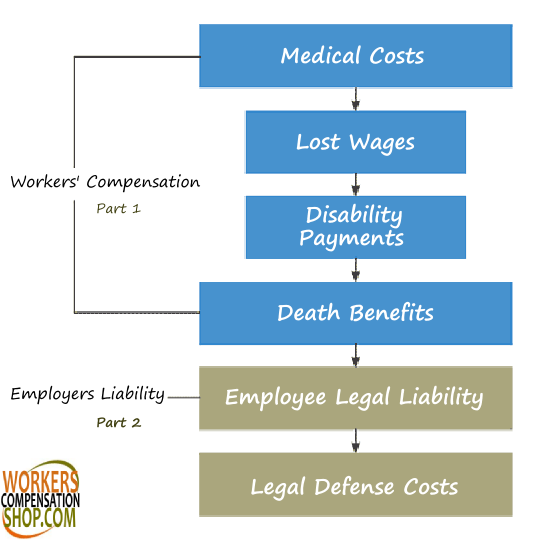
Workers' Comp Includes Employers Liability Insurance?
Employers liability insurance is an additional layer of coverage included as part of a workers' compensation insurance policy. Employers Liability is known as Part 2 of the policy. It adds two additional coverages for employers:
Employers Legal Liability and Legal Defense Costs
In today's world, there are a variety of reasons employees and third-parties sue employers for damages. Here a some common types covered by employers liability insurance:
Third Party Lawsuits
Your employee sues another party that may have contributed to the injury, In turn, the third party sues your business.
Consequential Bodily Injury
Another party or individual is injured while providing care for the injured employee.
Dual Capacity Legal Action
An employee files a claim but also attempts to sue the employer for being responsible in other ways outside of the employment relationship.
Loss of Consortium
A spouse sues for damages caused by the loss of companionship or relations.
Employers Liability coverage is not included with coverage in the four monopolistic states. Employers in these states can endorse this coverage onto their General Liability policy. That coverage is commonly known as Stop Gap Coverage.
- Employers liability coverage is not included in all monopolistic states.
- All NCCI and most other states' coverage includes employers liability insurance.
California DBA: I-Shop Online Insurance Agency.


