
How does workers' comp work in Oregon?
In Oregon, the rates on different class codes vary considerably between insurance companies. This makes it very important for employers to shop their policy with as many carriers as possible. The state of oregon recommends employers to shop their coverage with independent agencies who can offer quotes from 3 or more providers. We partner with more than 15 providers. This gives us a distinct advantage not many agencies have. We can give your business options from more providers and in turn find you better coverage at better rates.
The Department of Insurance allows insurance companies to issue credits and debits on policies up to 25%. If you are not shopping your coverage you could be missing out on huge discounts.
Call today to speak with one of our experts at 888-611-7467.
Workers' Comp Rules & Information for Oregon
Oregon Dept. of Consumer and Business Services
Workers' Compensation Division
350 Winter St NE, Rm 27
PO Box 14480
Calem, OR 97309-0405
503-947-7810
Oregon State Accident Insurance Fund (SAIF)
SAIF is a not-for-profit, state-chartered workers’ compensation company. They aim to make workers’ compensation insurance affordable and available to the employers of Oregon and strengthen the Oregon economy by helping to keep workers’ compensation insurance costs low. All while keeping the workplace safe for the worker's of Oregon.
What is Workers' Compensation?
The basic purpose of the Workers’ Compensation is to provide wage replacement benefits and medical treatment for employees who have been injured or become ill due to a work-related injury or illness. It prevents the employer from bearing the costs of injuries that occur during normal business operations.
How does workers' comp help my business?
Your business benefits by not being liable for injuries that occur as a part of normal business operations. This applies whether the injury was the fault of the business or was caused by negligent actions of the employee.
How does workers' comp help my employee?
Employees benefit from workers' comp coverage by having lost wages covered while they are hurt or sick and not able to work. It also pays for medical costs they might incur as a result of the sickness or injury.
State Insurance Directives Regarding Covid-19
Insurers cannot nonrenew or cancel liability coverage for child care facilities if the business justification for the cancellation/nonrenewal is an increased hazard due to COVID-19.
Mandatory order for all comercial liability carriers in effect from 03/25/2020 until further notice.
State Orders Regarding Insurance Claims Related to Coronavirus
Payments to employees furloughed or placed on administrative leave as a result of COVID-19 shall be classified as vacation time and excluded from payroll reported to workers compensation insurers for the for the purposes of calculating the premium basis. Vacation time is not an appropriate classification for sick leave or for employees teleworking or otherwise incurring risk covered by workers’ compensation insurance. Employers will need to separately track furlough payroll in sufficient detail for insurers to preform premium audits and insurers are required to inform employers of what information is necessary to perform premium audits and develop a plan to help employers comply.
Mandatory state law for Oregon. Effective 04/10/2020 untill further notce.
Specialized Programs for Select Industries
We work with our national insurance partners to develop targeted programs with easier underwriting requirements and lower rates. We offer a broad range of business class codes that help streamline the quote process so you get the lowest price for coverage.



How Does Workers' Compensation Work?
- What is Workers' Compensation?
- How Much is Workers Comp?
- Experience Modifiers & EMR Ratings
- Workers' Comp Class Codes
- 1099 vs W-2 Employee
- Workers Compensation Basics
- Employers Liability Insurance
- Workers' Compensation FAQ's
- Multi-State Insurance
- Workers' Compensation Laws
- State Insurance Fund
- Workers' Comp Claims
- Workers Compensation Benefits
- Managing Workers Comp Audits
- Workers' Comp Exemptions
- Ghost Policy
Strict Penalties for Noncompliance
Employers that do not purchase workers compensation will likely receive a notice of non-compliance from the Oregon Division of Workers Compensation. The penalty for the first offense is two times the amount of premium (minimum $1000). Employers are also liable for the cost of any claims and an additional $250 per day without coverage.
Let Workers Compensation Shop.com help your business navigate workers' comp insurance in Oregon.
From ownership rules, class code reviews, to managing audits & claims, we've got your business covered.
Our technology matches your business with insurance companies most likely to offer the best deals.
We leverage our experience and relationships to negotiate your lowest workers' comp rates.
No carrier quotes every class code. That's why we've built a diverse group of great insurance companies.
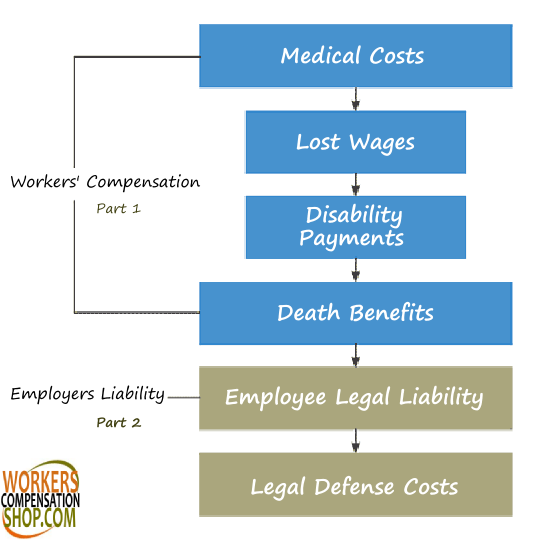
Workers' Comp Includes Employers Liability Insurance?
Employers liability insurance is an additional layer of coverage included as part of a workers' compensation insurance policy. Employers Liability is known as Part 2 of the policy. It adds two additional coverages for employers:
Employers Legal Liability and Legal Defense Costs
In today's world, there are a variety of reasons employees and third-parties sue employers for damages. Here a some common types covered by employers liability insurance:
Third Party Lawsuits
Your employee sues another party that may have contributed to the injury, In turn, the third party sues your business.
Consequential Bodily Injury
Another party or individual is injured while providing care for the injured employee.
Dual Capacity Legal Action
An employee files a claim but also attempts to sue the employer for being responsible in other ways outside of the employment relationship.
Loss of Consortium
A spouse sues for damages caused by the loss of companionship or relations.
Employers Liability coverage is not included with coverage in the four monopolistic states. Employers in these states can endorse this coverage onto their General Liability policy. That coverage is commonly known as Stop Gap Coverage.
- Employers liability coverage is not included in all monopolistic states.
- All NCCI and most other states' coverage includes employers liability insurance.
California DBA: I-Shop Online Insurance Agency.


