
How does workers' comp work in Washington?
In Washington, workers' compensation insurance is referred to as industrial insurance and is one of the oldest workers compensation systems in the country. The insurance is designed to protect both employees and employers from the financial impact of a work-related injury, accident, or disease.
Coverage is mandatory, and generally prevents an employee from being able to sue an employer for any damages. Coverage must be purchased though the Department of Labor and Industries (DL&I or L&I)). L&I manages all work comp claims and pays all employee benefits from the state pool known as the state fund.
The workers' compensation is a state regulated system and each state has their own laws and rules regarding coverage restrictions, rates, benefits, etc. Employers should always educate themselves regarding state laws on workers' compensation before doing work in or hiring employees from or other states.
Workers' Comp Rules & Information for Washington
Work Comp Coverage Exceptions in Washington
Employers are almost always required to provide state fund workers' comp to all employees except:
Failing to Report or Pay Work Comp Premium
If an employer fails to file a quarterly report, L&I will estimate the premiums due based on the best information they have on file and we will take steps to collect the premiums owed. They will also assess penalties on delinquent accounts. The longer the account is delinquent, the greater the penalty. The minimum penalty is $10. Employers must submit a report even if they report no hours/units and wages. A late report indicating “no hours/units” will be assessed a $10 penalty. Interest will be assessed on all delinquent accounts at a rate of 1% per month on the premium owed. We count the number of calendar days since the due date including the date we receive the report or payment. Other penalties may be assessed for nonpayment of premiums, misrepresentations, excessive deductions from employees, failure to keep adequate timesheets and payroll records or other violations.
Experience Mod Rating Factors
Experience rating is the result of an businesses workers’ exposure and actual claims, or losses, occurring during a period that we L&I refers to as the experience period .” The result will affect an employers workers’ compensation premium rates for a calendar year. Every eligible employer is experience rated in Washington on an annual basis. An eligible employer is an employer who reported worker hours or units during a given experience period. Businesses that have common majority ownership will generally be experience rated together on the same policy and share the experience factor with other commonly owned companies. In most cases, businesses that are sold and continue to perform the same operations in will have their experience rating factor transferred to the new business owners.
Out of State Employers Working in Washington
Out-of-State employers are permitted to bring workers into the state on a temporary basis (under 30 days) without paying premium to L&I under the following circumstances:
Working in Other States
L&I requires that employers pay premium to the state when employees travel out of state for fewer than 31 days in a calendar year regardless of whether or not premium was paid out of state or not. If employees are out of state more than 30 calendar days a year an employer can apply for out of state reporting. This allows them to only report and pay premium to the out-of-state insurance carrier.
Who Pays for Work Comp Coverage in Washington
Generally the employer always pays for workers compensation. Washington is the only state that allows the employers to deduct a portion of the cost of workers' compensation from the employees' wages. The employer can deduct up to half of the cost of the premium portion that pays the medical benefits and the portion of the premium that pays the cost of living increases for the injured workers drawing life-time compensation benefits or pensions. Employers must pay the entire portion of the premium that is used to pay loss time compensation and pensions. Overall, employees pay approximately 27% of the total work comp premium to the state.
Domestic Partners in Washington
Washington state law requires registered domestic partners to be treated in the same manner as married spouses for coverage.
State Insurance Directives Regarding Covid-19
P&C Insurers must provide grace periods for nonpayment of premium and waive other applicable charges and fees associated with nonpayment of premium (e.g., late fees; reinstatement fees). P&C insurers are prohibited from canceling a policy due to nonpayment of premium from March 25 to May 9, unless specifically directed to cancel by the insured. FAQs Guidance: 1) No policy can be canceled during the grace period, even if the notice of cancellation was sent prior to the effective date of the order. 2) The order covers all policies under the authority of the WA DOI. This includes policies that cover property or activity located in WA, but have a mailing address outside of WA 3) The order may apply to policies that have a WA mailing address but cover only locations outside of WA. It depends on whether any of the insurance transaction (e.g., solicitation, negotiation, execution of contract) occurred in WA or if the policy covers risk at least in part in WA or is to be performed in WA.
Mandatory law and order in effect from 03/13/2020 until further 05/09/2020.
State Orders Regarding Insurance Claims Related to Coronavirus
No current state orders.
Specialized Programs for Select Industries
We work with our national insurance partners to develop targeted programs with easier underwriting requirements and lower rates. We offer a broad range of business class codes that help streamline the quote process so you get the lowest price for coverage.



How Does Workers' Compensation Work?
- What is Workers' Compensation?
- How Much is Workers Comp?
- Experience Modifiers & EMR Ratings
- Workers' Comp Class Codes
- 1099 vs W-2 Employee
- Workers Compensation Basics
- Employers Liability Insurance
- Workers' Compensation FAQ's
- Multi-State Insurance
- Workers' Compensation Laws
- State Insurance Fund
- Workers' Comp Claims
- Workers Compensation Benefits
- Managing Workers Comp Audits
- Workers' Comp Exemptions
- Ghost Policy
Contractors and Sub-Contractors
Contractors who enter into an agreement with sub-contractors who does not have employees may be required to provide coverage for the subcontractor.
An exception to this rule exists when the sub-contractor supplies major equipment to the contractor for work purposes.
Notice- All information posted on this site is intended for informational purposes only and not intended to be legal advice.
From ownership rules, class code reviews, to managing audits & claims, we've got your business covered.
Our technology matches your business with insurance companies most likely to offer the best deals.
We leverage our experience and relationships to negotiate your lowest workers' comp rates.
No carrier quotes every class code. That's why we've built a diverse group of great insurance companies.
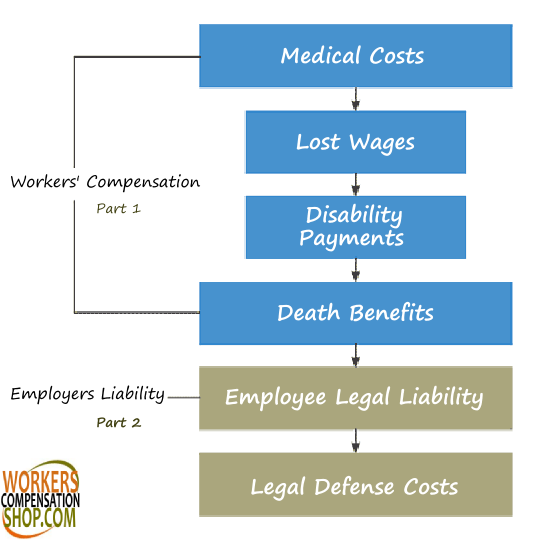
Workers' Comp Includes Employers Liability Insurance?
Employers liability insurance is an additional layer of coverage included as part of a workers' compensation insurance policy. Employers Liability is known as Part 2 of the policy. It adds two additional coverages for employers:
Employers Legal Liability and Legal Defense Costs
In today's world, there are a variety of reasons employees and third-parties sue employers for damages. Here a some common types covered by employers liability insurance:
Third Party Lawsuits
Your employee sues another party that may have contributed to the injury, In turn, the third party sues your business.
Consequential Bodily Injury
Another party or individual is injured while providing care for the injured employee.
Dual Capacity Legal Action
An employee files a claim but also attempts to sue the employer for being responsible in other ways outside of the employment relationship.
Loss of Consortium
A spouse sues for damages caused by the loss of companionship or relations.
Employers Liability coverage is not included with coverage in the four monopolistic states. Employers in these states can endorse this coverage onto their General Liability policy. That coverage is commonly known as Stop Gap Coverage.
- Employers liability coverage is not included in all monopolistic states.
- All NCCI and most other states' coverage includes employers liability insurance.
California DBA: I-Shop Online Insurance Agency.


